

Satellite Tracking Revived to Study Olive Ridley Turtle Movement Along Odisha Coast
Odisha Revives Satellite Telemetry to Track Nearshore and Long-Distance Migration of Olive Ridley Turtles

Odisha, home to some of the world’s largest nesting grounds of the Olive Ridley sea turtle, has once again taken a significant step to strengthen conservation efforts by reviving satellite telemetry studies to track the species’ movement along the coast and beyond.
Odisha’s Unique Role in Olive Ridley Conservation
Every year between February and March, thousands of female Olive Ridley sea turtles migrate to Odisha’s coastline—particularly Gahirmatha beach and the Rushikulya river mouth—to participate in a rare mass nesting phenomenon known as arribada. This natural spectacle has placed Odisha at the forefront of global marine turtle conservation.
Why Tracking Turtle Movement Matters
Understanding the movement patterns of Olive Ridley turtles is crucial to identifying critical habitats, reducing threats such as fishing bycatch, and designing effective Marine Protected Areas (MPAs). As a highly migratory species that traverses vast oceanic and often international waters, detailed knowledge of their feeding, breeding, and migration routes is essential for framing long-term conservation policies and addressing threats from coastal development and plastic pollution.
From Flipper Tags to Satellite Telemetry
Earlier conservation efforts relied mainly on flipper tagging to identify turtles returning to Odisha’s beaches for nesting. However, this method offered limited insight into their actual movement routes and offshore behaviour.
Recognising this gap, Odisha pioneered satellite telemetry studies in the early 2000s. The initiative, launched in 2001, marked a shift from beach-based monitoring to ocean-scale ecological research. These studies were carried out by the Wildlife Institute of India (WII) in collaboration with the Odisha Forest Department.
Satellite Tagging Re-initiated in 2024
Following decisions taken in a High Power Committee meeting chaired by the Chief Secretary of Odisha on December 18, 2024, the state decided to re-initiate satellite telemetry studies to better understand nearshore movements and beach dynamics of Olive Ridley turtles.
A tri-partite Memorandum of Understanding (MoU) was subsequently signed between the PCCF (Wildlife) & Chief Wildlife Warden, Odisha, the Wildlife Institute of India, Dehradun, and Dhamra Port Company Limited (DPCL).
Findings from the 2024 Tagging Exercise
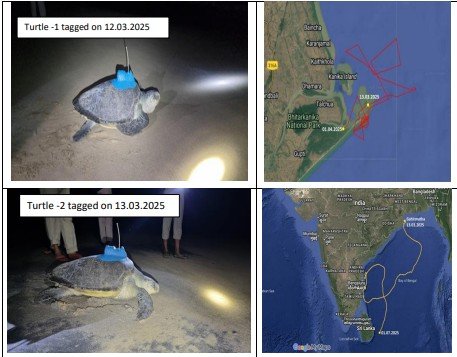
Under the programme, two Olive Ridley turtles were fitted with satellite transmitters.
-
Turtle-1 displayed nearshore movements around Wheeler Island, Babubali Island, and nearby spits before moving north of the rookery. The satellite tag later detached and was recovered from the mangrove habitat of Bhitarkanika, with the last recorded location dated April 1, 2025.
-
Turtle-2 undertook a long-distance migration, initially moving eastward into the open ocean, then approaching nearshore waters off Tamil Nadu before travelling southwards towards waters east of Sri Lanka.
These contrasting movement patterns highlighted the wide-ranging and complex migratory behaviour of the species.
Expanded Tagging Plan Approved for 2025
In the latest High Power Committee meeting held on December 17, 2025, it was decided to expand the satellite tagging programme. A total of nine Olive Ridley turtles—six from Gahirmatha and three from Rushikulya—are to be tagged. The group includes four males and five females.
Between December 21 and December 24, 2025, six turtles (three males and three females) were successfully tagged at Gahirmatha. The remaining turtles will be tagged at Rushikulya in the coming days.
Policy Support and Benefits for Fishing Communities
Officials believe that the expanded satellite tracking will generate vital data on nearshore movement patterns and habitat use. This information will help the government formulate evidence-based conservation policies while ensuring balanced development and safeguarding the livelihoods of local fishing communities.
The initiative reinforces Odisha’s leadership in marine conservation and underscores the state’s commitment to protecting one of nature’s most extraordinary migratory species.
Comments are closed.