
India’s Evolving Democracy: From One-Party Dominance to a Multi-Party Federal Landscape
From Congress Dominance to Coalition Era

Introduction
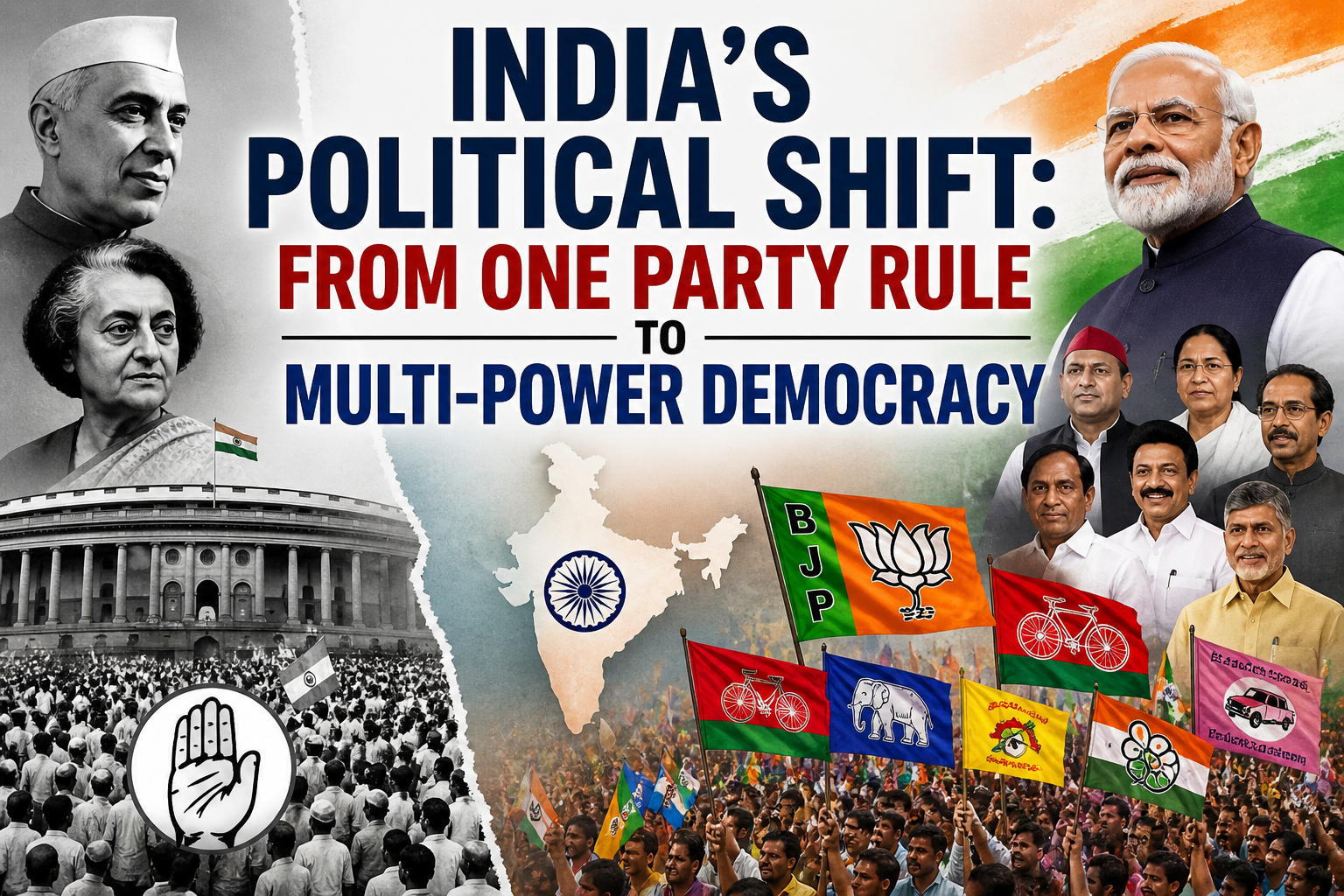
India, the world’s largest democracy, has witnessed a remarkable political transformation since its independence in 1947. From an era of single-party dominance to today’s complex multi-party and coalition-driven system, the country’s democratic journey reflects shifting voter preferences, rising regional aspirations, and evolving political ideologies.
The Era of Centralized Political Power (1947–1989)
In the early decades after independence, Indian politics was largely dominated by the Congress Party. Under the leadership of Jawaharlal Nehru and later Indira Gandhi, the central leadership held strong influence over national governance.
The period also witnessed significant political milestones and challenges, including the Emergency (1975–1977), which marked a controversial phase in India’s democratic history. Despite interruptions, Congress remained the principal force at both the Centre and in many states for decades.
Shift Toward Coalition Politics and Regional Rise (1989–2004)
The late 1980s marked a turning point in Indian politics. The decline of Congress dominance coincided with the rise of coalition politics and regional parties. The Mandal Commission implementation further reshaped India’s political landscape, strengthening identity-based and caste-based political movements.
During this period, national governance increasingly depended on alliances, leading to the formation of coalition governments at the Centre. Regional parties gained significant influence, especially in northern, southern, and eastern India, reshaping the federal balance of power.
Fragmentation and Regional Consolidation (1990–2014)
The 1990s and early 2000s saw the rapid expansion of regional political forces. Many state-based parties emerged, driven by linguistic, cultural, and regional identities.
While the Congress continued to play a role in national politics, it gradually lost ground in several states. The Bharatiya Janata Party (BJP) also began expanding its presence, particularly through mass movements and ideological campaigns such as the Ram Temple movement, which helped it establish itself as a major national contender.
Coalition governments led by alliances such as the NDA and UPA defined this era, with political power increasingly distributed among multiple stakeholders.
Rise of the BJP and National Consolidation
The BJP emerged as a dominant national force in the late 1990s and early 2000s under leaders like Atal Bihari Vajpayee. However, its expansion into a broad-based national majority was gradual and often dependent on coalition partners.
Over time, the party strengthened its organizational reach across states, significantly altering India’s political competition.
The Modi Era and “Double Engine” Governance (2014–Present)
The 2014 general elections marked a major political shift with the rise of Narendra Modi as Prime Minister. The BJP secured a strong majority at the Centre, ushering in a new phase of centralized leadership and development-focused governance narratives.
The concept of “double engine government” emerged, referring to alignment between state and central governments to accelerate development outcomes.
Since then, the BJP has expanded its presence across multiple states, while opposition parties have remained strong in select regions such as parts of southern, eastern, and northeastern India. Regional parties continue to play a crucial role in India’s federal structure.
India’s Political Landscape in 2026
By 2026, India’s political map reflects a deeply competitive and diverse democracy. The BJP and its alliances govern a large number of states, while opposition parties maintain strongholds in others.
States across India continue to be governed by a mix of national and regional parties, reflecting India’s pluralistic political structure. This diversity highlights the country’s federal strength rather than centralized dominance.
India’s democratic journey demonstrates a continuous evolution—from single-party rule to coalition politics and now to a competitive multi-party system shaped by regional aspirations and national narratives. Far from moving toward a single political center, India’s democracy continues to thrive on diversity, contestation, and voter-driven change.
Comments are closed.