
FSSAI Initiates Legal Action Against Bisleri Over Unsafe Drinking Water Sample; Know the Health Risks
FSSAI flags a Bisleri water sample for excessive bromate levels and PAHs, raising concerns over bottled water safety, potential health risks and long-term exposure to harmful chemicals.

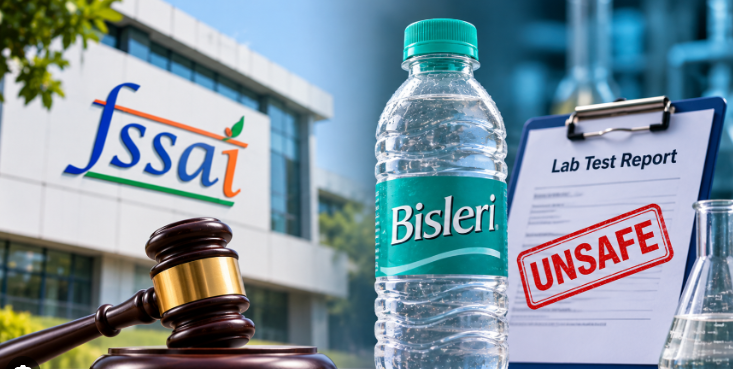
The Food Safety and Standards Authority of India (FSSAI) has authorised legal proceedings against Bisleri International over a sample of its packaged drinking water that was declared unsafe following laboratory testing.
The sample reportedly contained bromate levels exceeding the prescribed safety limit. It also tested positive for polycyclic aromatic hydrocarbons (PAHs), raising concerns about the safety of the packaged drinking water.
The development has triggered a major question among consumers: Can bottled water, which looks clean and transparent, also contain harmful chemicals? What are the possible health risks of consuming chemically contaminated water? Let’s understand.
How Dangerous Is Chemically Contaminated Drinking Water?
According to Dr Rajeev Dang, Director and Head of Internal Medicine at Max Hospital, water is essential for the human body. However, drinking water contaminated with harmful chemicals can pose serious health risks.
The impact largely depends on the type of chemical present, its concentration and the duration of exposure. Regular consumption of chemically contaminated water over an extended period can lead to serious health complications.
Risk of Cancer and Kidney Damage
Dr Dang explained that consuming contaminated water may cause several immediate health problems, including stomach pain, vomiting, diarrhoea, nausea and digestive disorders.
Long-term exposure to toxic substances such as arsenic, lead and mercury can damage vital organs, particularly the liver and kidneys.
In certain cases, prolonged exposure to specific harmful chemicals may also increase the risk of cancer. Children and elderly people are particularly vulnerable to the adverse effects of contaminated drinking water.
Can You Identify Harmful Chemicals Through the Taste of Water?
A common misconception is that water is safe to drink if it tastes normal. However, several harmful chemicals can remain present in drinking water without causing any noticeable change in its taste, colour or smell.
Therefore, the purity of water cannot be determined simply by tasting or smelling it. Scientific laboratory testing is necessary to identify chemical contamination and establish whether the water meets prescribed safety standards.
However, this does not mean that all packaged drinking water is unsafe. Bottled water that meets the required quality and safety standards and contains harmful substances within permissible limits is generally considered safe for consumption.
Bisleri Issues Clarification
Meanwhile, Bisleri International has issued a clarification regarding the matter, maintaining that its packaged drinking water is safe for consumption.
According to the company, the case is around 14 months old. Of the six samples examined, five were found to be compliant with the prescribed standards. Only one sample reportedly showed bromate levels slightly above the permissible limit.
The company reiterated that consumer safety remains its top priority and that it follows stringent quality control procedures to ensure the safety of its drinking water.
Bisleri also stated that it would extend full cooperation to FSSAI and follow the appropriate regulatory process to resolve the matter.
The development has once again highlighted the importance of food safety regulations, regular quality checks and scientific testing to ensure the safety of packaged drinking water.
Comments are closed.