

El Niño Alert: India Faces Severe Heatwave and Rainfall Uncertainty
Severe Heatwave Grips India as Temperatures Cross 45°C

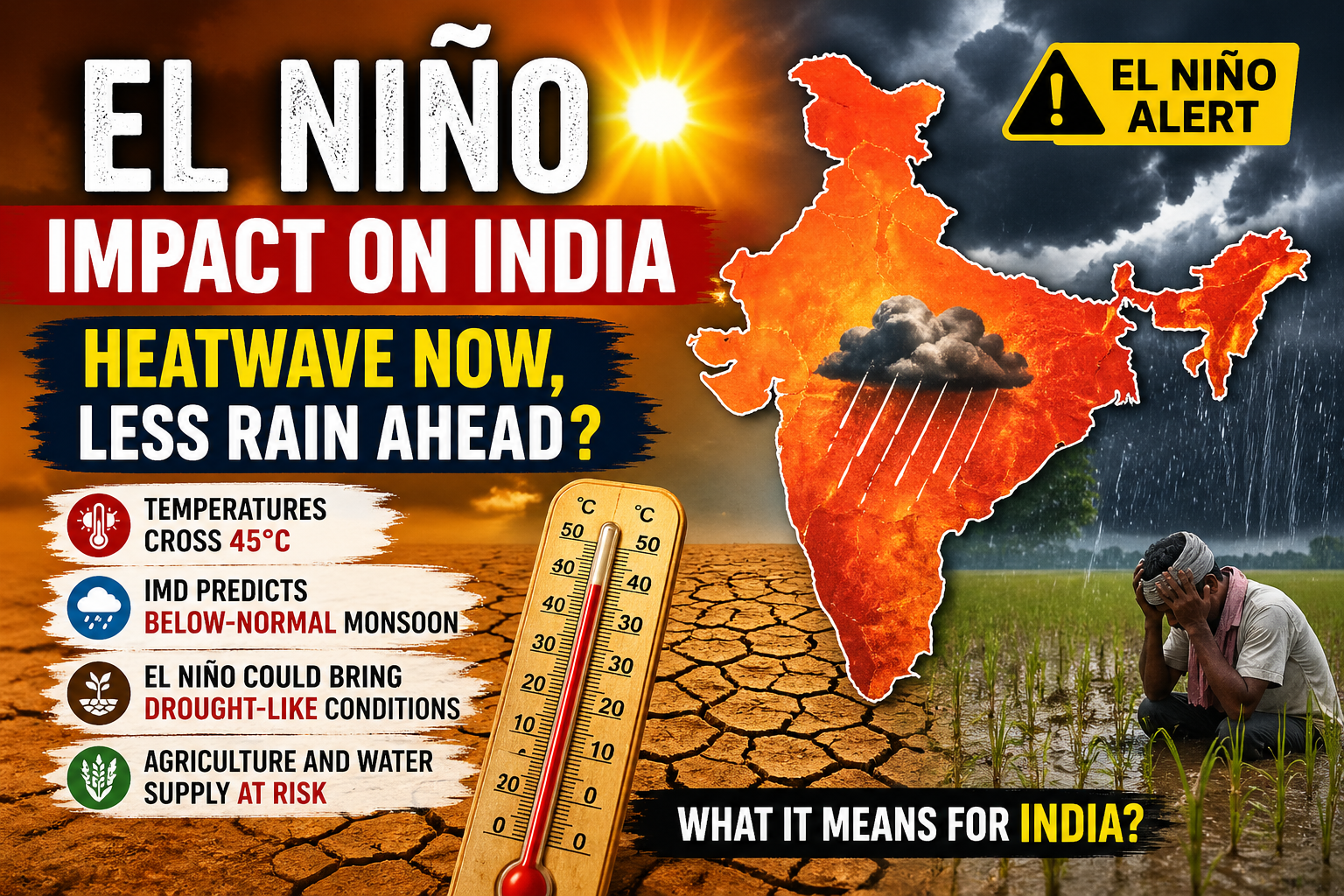
Extreme Heatwave Grips India as Temperatures Cross 45°C
India is currently witnessing an intense heatwave, with temperatures crossing 45°C in several regions. The India Meteorological Department (IMD) has issued repeated warnings as the mercury continues to rise day by day, making outdoor conditions extremely harsh and unbearable for the public.
Meteorologists report that temperatures are breaking seasonal records, raising serious concerns about public health, water scarcity, and agricultural stress.
IMD Warns of Below-Normal Monsoon Rainfall
The India Meteorological Department has forecast that the upcoming southwest monsoon (June–September) may bring below-normal rainfall across India.
According to the forecast, rainfall could be lower than average by around 8%, increasing the risk of drought-like conditions in several states. The weakening of La Niña conditions and the strengthening possibility of El Niño are being cited as key reasons.
El Niño Conditions Likely to Strengthen
The World Meteorological Organization has warned that El Niño conditions could become more active between May and July 2026.
El Niño is a natural climate phenomenon that occurs when sea surface temperatures in the central and eastern Pacific Ocean become unusually warm. This disrupts global weather patterns, often leading to reduced rainfall in India and increased global temperature anomalies.
Experts say that if El Niño strengthens, it may further intensify heatwaves and reduce monsoon performance.
Agriculture Sector at Risk
India, being an agriculture-dependent economy, is highly sensitive to monsoon variations. A weak monsoon linked to El Niño conditions could significantly affect crop production, especially rice, pulses, and sugarcane.
Farm experts warn that reduced rainfall may also impact irrigation systems and increase dependency on groundwater, worsening long-term water stress.
El Niño and La Niña Explained
El Niño and La Niña are opposite phases of a climate pattern known as the El Niño–Southern Oscillation (ENSO).
- El Niño: Occurs when Pacific Ocean waters become warmer than usual, often leading to weak monsoons and drought-like conditions in India.
- La Niña: Occurs when ocean waters become cooler than normal, usually resulting in stronger monsoons and heavy rainfall.
The transition between these phases significantly influences global weather systems, including storms, droughts, and temperature variations.
Past El Niño Impact in 2023
The last major El Niño event began in mid-2023 and had a significant impact globally. India experienced below-average rainfall, with August 2023 recorded as one of the driest months in over a century.
Crop yields declined, leading to restrictions on rice exports and a rise in food prices. The year 2023 was also recorded as one of the hottest years globally, with abnormal temperature spikes even during winter.
Growing Global Concern
Climate scientists warn that increasing frequency and intensity of El Niño events may be linked to broader climate change trends. Rising global temperatures, unpredictable monsoons, and extreme weather events are becoming more common, raising long-term concerns for agriculture, water security, and public health.
Authorities continue to monitor oceanic and atmospheric conditions closely as India prepares for a potentially challenging monsoon season ahead.
Comments are closed.