

India’s ‘Artificial Sun’ Takes a Major Step Forward in Nuclear Fusion Research
New 82.6 GHz, 400 kW gyrotron commissioned at Gujarat’s SST-1 tokamak to advance India’s nuclear fusion research

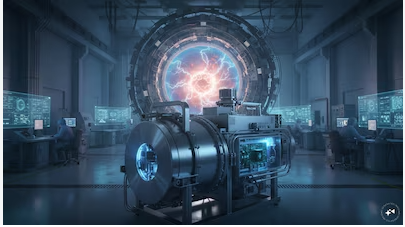
India has achieved a significant milestone in its efforts to advance nuclear fusion research, with scientists commissioning a new high-power gyrotron on the SST-1 tokamak at the Institute for Plasma Research (IPR) in Gujarat.
The newly installed gyrotron operates at 82.6 GHz and can deliver up to 400 kW of radio-frequency power. According to IPR, the system is integrated with SST-1 for Electron Cyclotron Resonance Heating (ECRH), which is used to heat and control extremely hot plasma during fusion experiments.
The development is being described as a step forward in India’s quest to recreate conditions similar to those inside the Sun on Earth. Fusion research aims to replicate the process through which stars generate energy by combining light atomic nuclei at extremely high temperatures.
Plasma hotter than the Sun
Indian fusion experiments have already achieved plasma temperatures exceeding 200 million degrees Celsius. This is around 20 times hotter than the temperature at the core of the Sun.
However, generating extreme temperatures is only part of the challenge. Scientists must also keep the ultra-hot plasma stable and confined for sufficiently long periods to study controlled fusion.
Unlike the Sun, where enormous gravitational pressure confines the plasma, tokamaks use powerful magnetic fields to keep the plasma away from the reactor walls. SST-1 is a doughnut-shaped superconducting tokamak designed for experiments involving magnetically confined plasma.
How does the gyrotron work?
A gyrotron is a high-frequency microwave device used to deliver energy to plasma. The new 82.6 GHz system provides up to 400 kW of RF power and is being used for electron cyclotron heating experiments on SST-1. IPR says the system can be used for plasma heating, breakdown, current-drive studies and plasma control.
The powerful microwave energy helps researchers heat the plasma and investigate its stability, confinement and behaviour under extreme conditions.
The ultimate goal: Fusion energy
Nuclear fusion involves combining light nuclei, such as hydrogen isotopes, under extreme conditions. Deuterium and tritium are among the fuels being studied for fusion, with the reaction producing helium, neutrons and a large amount of energy.
The long-term objective is to harness this energy for electricity generation. However, India’s SST-1 remains an experimental research facility and is not currently generating electricity from fusion. Significant scientific and engineering challenges still need to be overcome before commercial fusion power becomes a reality.
The commissioning of the 82.6 GHz, 400 kW gyrotron therefore represents an important enhancement to India’s experimental capabilities, particularly in the effort to heat, control and sustain ultra-hot plasma for fusion research.
Comments are closed.