
Modi Government Completes 12 Years: Major Policy Decisions Shape India’s Political Landscape
Modi Government Completes 12 Years in Power

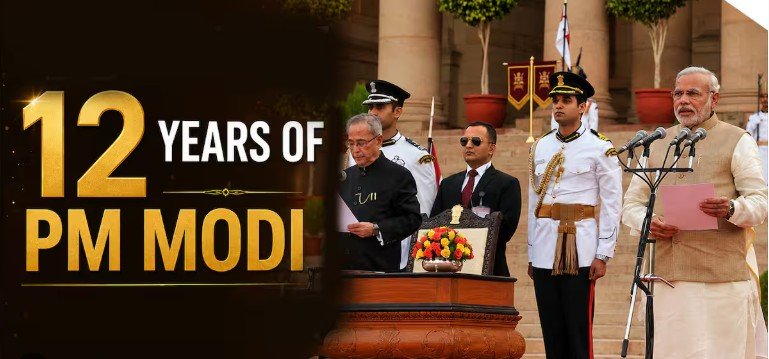
The Narendra Modi-led government has completed 12 years in office, marking a significant milestone since he first took oath as Prime Minister on May 26, 2014. Over the years, the administration has been widely associated with bold policy decisions, structural reforms, and major socio-economic changes across the country.
From 2014 to 2026: A Transformational Journey
Since taking office, Prime Minister Narendra Modi has been credited with strengthening India’s global image and implementing several high-impact reforms. The government has consistently highlighted its focus on decisive governance, economic transformation, and national security.
Abrogation of Article 370 in Jammu and Kashmir
One of the most significant decisions was the abrogation of Article 370 in August 2019, which removed the special status of Jammu and Kashmir. The region was subsequently reorganized into two Union Territories, marking a major constitutional and political shift.
Women’s Reservation Bill Passed
The government also passed the Women’s Reservation Bill, ensuring 33% reservation for women in the Lok Sabha and state legislative assemblies. The move is expected to enhance women’s participation in Indian politics.
Demonetisation and GST Reform
In 2016, the government announced demonetisation, invalidating ₹500 and ₹1,000 currency notes to curb black money and corruption. Another landmark reform was the implementation of the Goods and Services Tax (GST) in 2017, introducing the “One Nation, One Tax” system.
Major Social and Legal Reforms
The abolition of triple talaq criminalized instant divorce among Muslim men, strengthening legal rights for women. The Agnipath scheme introduced a new recruitment model for the armed forces, while reforms in education led to the implementation of the National Education Policy after 34 years.
Ram Temple, CAA, and Security Actions
The construction of the Ram Temple in Ayodhya followed a Supreme Court verdict, with its consecration held in 2024. The Citizenship Amendment Act (CAA) was also introduced to provide citizenship to persecuted minorities from neighboring countries. On the security front, India conducted surgical and air strikes as part of its counter-terrorism strategy.
Digital India and Welfare Expansion
Programs like Digital India and Jan Dhan Yojana have expanded financial inclusion and digital payments through UPI. The government also introduced EWS reservation, providing 10% quota for economically weaker sections.
Over 12 years, the Modi government has implemented a series of bold and controversial decisions across governance, economy, security, and social welfare, shaping its vision of a “Developed India.”
Comments are closed.