
El Niño Strengthens Over Pacific, Raising Global Weather Concerns
Strong El Niño May Trigger Extreme Heat, Floods and Drought; India Faces Possible Monsoon Impact

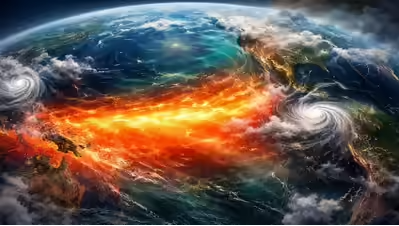
Concerns over global weather patterns are growing as the El Niño phenomenon strengthens over the Pacific Ocean. Rising sea surface temperatures and the strengthening El Niño could trigger significant changes in weather patterns across different parts of the world, with some regions potentially witnessing floods, while others may face drought and extreme heat.
According to the latest assessment by the World Meteorological Organization (WMO), El Niño is now firmly established and could strengthen further in the coming months, potentially reaching a “very strong” level.
The WMO assessment indicates that there is a very high probability of El Niño continuing until February 2027. Sea surface temperatures in the Niño-3.4 region remained around 1.5 degrees Celsius above normal between May and July, with the anomaly reportedly reaching nearly 2 degrees Celsius in July.
The rising temperatures in the Pacific are raising concerns about their possible impact on weather systems around the globe.
What Could El Niño Bring?
The impact of El Niño is not expected to be uniform across the world. Changes in atmospheric circulation and rainfall patterns could lead to excessive rainfall and flooding in some regions, while others could experience prolonged dry conditions and drought.
Several areas could also witness unusually high temperatures and potentially extreme heat events. A shift in rainfall patterns could have consequences for agriculture, water resources and food production.
Why India Is Watching Closely
For India, the development is particularly significant because El Niño has historically been associated with a weakening of the Indian summer monsoon.
The latest WMO assessment also points towards the possibility of below-normal rainfall over parts of the Indian subcontinent. If rainfall remains deficient, the impact could extend beyond agriculture, affecting water availability, irrigation, reservoirs and food production.
However, experts caution that a strong El Niño does not automatically mean that India will experience deficient rainfall across the entire country.
Indian Ocean Dipole Could Play a Role
Apart from El Niño, the Indian Ocean Dipole (IOD) is another important factor that can influence India’s monsoon.
There are indications of a positive IOD alongside El Niño, making the overall weather scenario more complex. The interaction between these climate patterns could influence rainfall distribution and temperatures across different parts of India.
Weather experts therefore emphasise that the strength of El Niño alone cannot determine India’s monsoon outcome. Regional rainfall and temperature patterns will also depend on several other atmospheric and oceanic factors.
With El Niño expected to persist into early 2027, meteorological agencies and policymakers are closely monitoring developments for their potential impact on rainfall, agriculture, water resources and extreme weather events in India and across the globe.
Comments are closed.